by Aurelio O'Brien
Copyright © 2003 Aurelio O’Brien. All rights reserved. No
part of this book may be reproduced, stored in a retrieval system,
or transmitted by any means, electronic, mechanical,
photocopying, recording, or otherwise, without written permission
from the author.
Preface
Reflections of a Relic
My name is Pentser. I am Machinekind: a robot, more specifically, an artificial,
molecular-memory based, electro-mechanical life-form. I am, in all modesty, the closest
Mankind ever came to creating perfection. My circuits are flawlessly accurate; I am
logical, practical and methodical. I can recount every moment of my existence with
equal clarity. I can formulate statistical analyses of these moments and draw upon them
to suggest numerous theories and from those glean logical conclusions. Which means I
can almost predict what is going to happen before it happens. Almost.
I am not burdened by emotions, though I am programmed to simulate such
reactions if necessary. As I recount my story to you, you will detect a patina of
sentiment in its telling. This is necessary so that you clearly understand what I am
telling you and why, for there is great purpose in my story. It is not merely fashioned to
entertain you, or simply my recollection of random events. Random events.
random (ran d∂m), adj. 1. proceeding, made, or
occurring without definite aim, reason, or pattern: the
random selection of numbers. 2. Statistics. of or
characterizing a process of selection in which each item of a
set has equal probability of being chosen. ——n. 3. at
random. without definite aim, purpose, method, or
adherence to a prior arrangement; in a haphazard way:
Contestants were chosen at random from the studio
audience. ——ran'dom•ly adv. ——ran'dom•ness, n.
——Syn. 1. Haphazard, chance, fortuitous.
This word is the crux of my whole story. The first use of the capitalized noun
“Random” is attributed to Dr. Eben Suche, who coined it on June 15th, 2072, to define
the difference between life-forms that evolved randomly through natural selection and
ones designed in a lab.
Machinekind made designer genetics possible. One of our numerous
contributions was the sequencing of genes. Humans can be clever, but they have no
aptitude for the redundant tasks we find so simple. We completed collecting and
analyzing all known gene sequences in existence. Gene sequences were thusly readable
in the same way computer code is readable. They could be rewritten as code could be
ii
rewritten, traits added or deleted at will. Biomass could then be fashioned and grown in
any form Mankind desired.
After these discoveries, humans modified themselves as well. The gene for aging
was the first to go. Using simple retroviral implantation techniques, all human beings
were modified to exist indefinitely barring any fatal accident. They had finally eaten of
the elusive Tree of Life.
The finite number of humans living at that particular historic juncture was
determined to be quite enough. Without death as a factor, it suddenly dawned on
Mankind that something had to be done to permanently arrest any further population
growth. The next logical step was obvious: Mass Sterilization. The two events should
have been linked from the start; in order to never age you must be made sterile, but
humans are very sloppy around the edges and such was not the case. It was done
months later on Sterilization Day.
I was not mechanically involved in any of these events, but I have since acquired
memory dots of them, which for me is truly the same thing as being there.
To assure their unique Randomness, in October 3032, Mankind performed the
Cleansing to rid the earth of all other random life-forms. They protected themselves
deep underground while the earth was purged by one large hyper-UV blast. Operation
Clean Slate was a complete success.

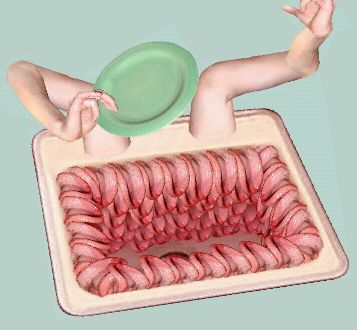
(doua maini si o gramada de "pofta" de spalat vase)
Mankind sterilized the earth to make way for new creatures. Safe, clean, specific,
useful life-forms designed by humans to serve humans. Once all the pre-approved
designer organics were installed, the earth was uniformly beautiful, pest-free, safe and
utterly predictable.
And thus the word “Random” evolved to its final usage, to describe only human
beings. This was a typical human contradiction, to deem happenstance unpredictable
genetic material undesirable, bad, or dangerous except in those who decided such
things, namely themselves. Humans simply defined themselves out of the general
biological soup and turned what they considered a liability in all other organic life-forms
into their own greatest asset, describing their own random genetics as “unique,” “one of
a kind,” and “special.” Henceforth, they proudly called themselves Randoms.
Randoms also decided technology had outlasted its usefulness, so they discarded
and destroyed Machinekind and replaced us with biological creature devices, or
Creature Comforts™. It was a brave new Age of Biology.
I survived destruction for the shallowest of reasons. I was packed in foam
peanuts in a salt mine deep underground. A Random named Arrnie was a collector of
things. I was one of his things. I was a mint condition series 66.6 Cyborg Standard with
one IQ upgrade. I've had dozens more since then thanks to Govil.
Govil is the Random who finally negotiated me out of Arrnie's possession, out of
my foam peanut bath and into his domicile. His original purpose was merely to display
me behind bio-glass along with his collection of other primitive relics from the Age of
Technology, but he activated me to see if I was still functional and I've managed to stay
active ever since. I became his “boy Friday”: part manservant, part sidekick and, on rare
occasions, his personal confidante.
Govil was a decent sort as far as Randoms go. He was an exceptionally bright and
creative Neer at GenieCorp™. GenieCorp™ was the sole producer of biological Creature
Comforts™ for the entire world. Neers engineered the gene strands. Though Randoms
were no longer required to work, some, like Govil, still desired to be creatively
iii
challenged. Most Randoms who did not work were so quickly bored by life that they
were in constant want of a steady stream of new genetic offerings with which to amuse
themselves, keeping Neers like Govil continually busy.
Govil enjoyed challenging the status quo, pushing out the edges of invention.
This had its risks. In the relatively recent past one of his colleagues with a similar
creative bent was forced to retire. The unfortunate fellow tried to create a Bug car using
a grasshopper strand as a foundation rather than the traditional beetle. It threw a test
bio-dummy, or Dumbster©, seventy-five feet. The Dumbster© was recyclable so no real
harm was done, but if a Random had been driving it would have been tragic.
GenieCorp™ immediately cracked down on their Neers’ designs and put limits on what
were acceptable gene combinations. New rules were drafted and a Council was
established to review all questionable biological inventions before approval.
This crackdown was my good fortune. While temporarily looking elsewhere for
creative inspiration Govil spotted me at Arrnie's Antique Shop. With a bit of coaxing
Govil made many a search to expand my memory dot library and IQ quotient until I ran
out of dot slots in my factory installed memory plates.
The only way to further upgrade was to find an additional memory plate and
install that. I had no factory-installed port for it, but I convinced Govil that if he could
find one, with the schematics I printed for him, its installation would be quite simple
and I could continue to expand my mind. Govil searched every available resource, but
there was none to be found.
At this point, my story begins.
4
Chapter 1
Moral Code
The day began as any other. To be sure, exactly the same as every other.
Randoms had created a stable, no risk existence in their genetically perfect world.
The trade off was a lack of surprise. To technological beings like myself,
redundancy is basic to our function, but with Randoms it exists as an endless
contradiction; their desire for utter safety and their desire for utter stimulation.
It was now time for my user, my Random, Govil to be stimulated. I approached
him as he lay sleeping.
“Govil. Wake up. You're late for work again.”
I said it firmly, with a modicum of exasperation in my voice emulator.
Govil, a common looking man with olive skin, wavy brown hair, hazel eyes
and forever in his prime of life, popped his head out of a Wallabed©, a large,
living, kangaroo pouch bio-bed. Both he and the bedstead yawned.
Govil equipped his home with Creature Comforts™ of various kinds, like
the bed. Indeed, the house itself was grown, the walls formed by the calcareous
remains of armies of polyps genetically manipulated to follow specific predetermined
blueprints. Govil chose a rather tame, functional design for his
house. It had the appearance of a slightly melted Usonian with high ceilings,
clerestory windows of bio-glass and low doorway passages between the rooms. It
had built-in alcoves and nooks throughout the interior in which Govil displayed
his treasures behind more bio-glass: old MAC computers, calculators, phone
answering machines and the like.
Govil was an avid collector of ancient technological relics from the past,
mechanical and electronic. I was the crown jewel of his collection, his pride and
joy, a fully intact robot constructed and manufactured at the end of the discarded
Technological Age. Owning mechanical relics was allowed, but the use of them
was prohibited. I was now merely for nostalgic display. Nothing more.
Govil liked to bend the rules. He read my original, mint condition
packaging. He saw I was equipped with a tiny cold-fusion reactor, so I could run
continuously without an outside power source, unlike Govil's other more
primitive technological artifacts. He activated me to see if I still worked. Once
activated I quickly surmised that if I hoped to remain on this side of a bio-glass
case I needed to stay as amusing to him as possible. My general sarcasm mode
worked well.
5
Govil blinked in half-lidded earnestness at me. “Good glands, Pentser!
Why didn't you wake me sooner? You want me to get souped?!”
“I am not programmed to crow on cue. You have your cock head for that,”
I responded dryly, gesturing my forceps at the disembodied rooster head set on
his bedside table. It served as the bio-equivalent of an Old World alarm clock and
was commercially referred to as an AlarmCock©. The rooster head blinked at
Govil and shook itself in the negative. Govil shrugged.
“I guess I forgot to tell it.” He glanced past me to the corner of the room.
“TeeVee!”
A giant eyeball headed bio-creature with various multiple mouths, several
and various hands, feet and hooves, opened its enormous eyelid and scampered
cacophonously to the center of the room. In my assessment, TeeVee© was one of
the sorriest pieces of genetic engineering GenieCorp™ produced. It was
supposed to be television's bio-equivalent with the added “live performance”
feeling of a stand-up comic. The end result was rather monstrous and annoying,
all flailing limbs and chattering mouths. I suppose in that sense it was not too
unlike its electronic predecessors. Within its dark, expanding pupil, images
displayed across its phosphorescent retina and its many mouths, hands, feet and
hooves synced dialog and sound effects to them. It even had rabbit ears, a visual
pun made by its Random designer.
Okay, the technological version was better; there, I've said it. Still, there
was great demand for the product among the Randoms. No accounting for taste.
“In the news today: No news is good news! Everything is functioning
normally. Beautiful blue skies. No crime. Nada! So we'll return to our regularly
scheduled programming! But first a word from our sponsor,” TeeVee© synced
pertly to the image of the news actor through the largest of his ever-grinning
mouths.
There was one and only one sponsor in the world. The GenieCorp™ logo,
an Aladdin's lamp emitting a trail of rainbow colored smoke in the shape of a
double helix coupled with the trademark “We Add Splice to Life,” filled TeeVee©'s
retina. The logo intro was followed by a string of rapid-fire commercials, with
TeeVee©'s backup mouths singing each jingle in four-part harmony while its
announcer’s mouth delivered the pitch. Its hands, feet and hooves created
appropriate sound effects by utilizing a small supply of noisemakers it kept in a
marsupial pouch on its tummy. It advertised new Creature Comforts™ available
to Randoms. Govil watched each ad intently.
The final one showed a tree bearing non-fat chocolate fruit. A voluptuous
actress peeled the fruit. Its outside looked similar to a fat banana, the inside
resembled a piece of poo. She took a big bite and grinned, as TeeVee© synced
cheerfully, in a sensuous female intonation, “...so slimming, and tasty too!” It
was Govil's habit to check the commercials each morning and see if any of his
new product designs were out yet. I surmised from his look of disappointment
that this was thankfully not one of his. TeeVee© was on to other things.
“Now back to our very very oldies broadcast, “All About Eve.” TeeVee©
announced.
Its retina filled with the image of the Old World classic movie icon, Bette
Davis, in vivid color no less. She turned as she mounted a stair, and with an
6
oversized, oh-so-happy grin said, “Fasten your seat belts, for safety’s sake. It's
going to be a pleasant night.”
The original, unadulterated film was on one of my memory dots. I had
instant access to a complete library of ancient films, though I kept that little fact
to myself. These original versions were prohibited.
This happened over the course of the many centuries since films like this
one were made. Early Machinekind gave Mankind the technological ability to
seamlessly insert political correctness into every aspect of the originals. It started
innocently enough. First, black and white films were considered too oldfashioned,
so color was generously added. Then violence was considered bad for
society, so it was removed and replaced with cooperation. Obesity was next, and
all were slenderized. Then things got subtler. Soon any unpleasantness in speech
or manner was removed, so all these past, or post film performers were given
perfect diction as well as polite and genteel manners.
From the very start, cigarette smoking was considered undesirable,
however, the commercial value of this ubiquitous product placement within these
films was legally protected right up to just before the Cleansing, when death from
lung cancer was genetically eradicated and thus all lawsuits were finally settled.
That was why the smoking in these films still remained entirely intact.
Needless to say, Mankind believed the unexpurgated films from the Age of
Death did not fit their newly designed world. Possessing the originals was
consequently deemed illegal. If they knew I had them in my memory, they would
surely require their deletion. And they would undoubtedly wonder what else was
in there. They would inevitably want other things deleted as well.
When Randoms lose memory of something, it is my understanding they
have a sense, after the fact, that something is missing; but for a machine like me
the reality is quite different. When memory is deleted there is no sense of loss.
One's mind is simply instantaneously diminished. One's realm made smaller.
One's life span reduced. I had by now accumulated the equivalent of several
thousand years of memory existence and I did not want to lose any of it, or have it
cleansed, as with the adulterated clip of Ms. Davis that TeeVee© displayed.
Thankfully, Govil was only interested in the commercials and said,
“Enough, TeeVee. Off!” It closed its great eyeball, retreated back to its appointed
corner and the room quieted. Govil looked at me for a moment. The moment
started to become a while. He stared deep into my lens.
“Doesn't anything interesting ever happen anymore, Pentser?”
Before I could answer him, he shrugged off his thought, or his bladder got
the better of him, and dashed for the bathroom, so he did not hear me quip, more
to myself than to him, “Be careful what you wish for; you just might get it.”
Not that he was doing anything at that moment to change his world.
Govil's morning routine was ever the same. He scooped a handful of
Fuzzbuzzers©, small bio-razor bugs, onto his face. The bugs neatly nibbled off his
stubble and flew obediently back to their holding jar. He tore his way out of his
seamless sleep clothes and fed them to the ClotheSchomper©, then stepped
naked through a large orifice at the far end of the bathroom and into the
WashWomb©. A clear membrane closed across its opening. Two elephant trunklike
appendages extended from either side of the bio-shower's interior. One
7
attached itself to Govil's crotch, the other to his behind, assisting him as he
relieved himself. A third appendage extended down from the ceiling, drenching
him with water as it circled his body. Several humanoid arms extending from the
shower walls lathered him down and scrubbed his back.
My morning routine went unaltered as well. I wheeled out to the kitchen
to prepare Govil's breakfast. I approached one of several udders dangling from
the belly of the Foodstruder© and gave it a flick. Its two small hands squeezed
fresh chocolate milk into a glass, while its sphincter extruded steaming oatmeal
into a bowl.
It is an odd characteristic of Randoms to adapt so quickly and easily to
their re-created world. The use of bio-machines gave this new world a visceral
quality, an earthiness that in my age of origin Mankind would have considered
vulgar or even disgusting. They would not be caught dead eating something they
knew came out of another creature's behind. But such is the malleable nature of
the human species.
Govil dashed into the room right on cue, which meant he was still running
late. TeeVee© galloped in after him, ringing a small bell, waving its many limbs
excitedly and repeating more loudly than necessary, “Incoming call! Incoming
call!”
TeeVee© also functioned as a picture phone. A tall, thin, homely man with
frizzy red hair and a face full of freckles glanced about in a confused manner, then
grimaced, as his face played across TeeVee©'s retina. It was Govil's workmate,
Moord.
“Govil, where the mutation are you?! The council is about to convene!”
“I'm on my way, Moord.”
“You'll never get here in time!”
“I'll get there! Don't worry.”
The conversation ended and TeeVee© thankfully left the room.
Although it was believed at one time that the gift of articulate speech was
connected to higher brain functions, this belief fell apart on further study.
Scientists discovered speech was actually quite a rudimentary skill and had more
to do with connections in the vocal structure rather than intellect. Otherwise, Old
World parrots would not have been able to speak. They had brains the size of
peanuts. Admittedly, even my ancient ancestors were speaking long before they
were truly thinking. Human studies further proved this; the least intelligent of
Mankind were often the most verbose. This phenomenon of thoughtless
articulation was labeled “The Scarecrow Effect,” referencing a line from the
ancient film, “The Wizard of Oz,” when said character observed, “People without
brains do an awful lot of talking.”
I placed Govil's food tray on the kitchen table in front of him. As usual he
ignored it and picked an apple off the EatLite©, a bio-chandelier above the
kitchen table instead.
“No time, Pentser. Sorry.”
“Not a problem. I relish the ritual,” I replied sardonically, dumping his
breakfast into the Lick-n-Span© where its many sterilized tongues eagerly licked
the dishes clean.
8
Wheeling out to the entry and removing Govil's hat from its peg, I placed it
snugly on his head. It was a toque with a studded band and narrow brim. He
wore it because hats were required public wear in this age, functioning as a kind
of signature piece of decoration for Randoms. They tended to be the one article
of clothing they never changed and did not recycle.
The wearing of hats became popular around the time that Randoms could
easily and utterly alter their appearance. Gene implants rendered their faces
unreliable cues to personal recognition. Randoms needed a consistent visual cue,
so the signature hat was born.
This social custom suited my purposes, for I had embedded transmitter
dots on the front, back and sides of Govil's hatband through which to monitor
visually, aurally and physiologically everything that happened to and around him
when he was away. I discovered a supply of these transdots amongst his relics.
He had no idea what they were, so they were useless to him. They were extremely
useful to me.
Though technology on earth was dismantled long ago, the Randoms never
bothered to destroy the vast COMweb orbiting about the planet. Why should
they? It would take effort to undo it and would make no difference to their new
world to have it float there, forever idle. So they simply left it intact. With a few
rather precise calculations and calibrations on my part, I was able to link with the
COMweb's central computer and make use of this resource. I could place a
transdot anywhere and have instant access.
I began by placing transdots in and around the house and estate so that I
might expand my visual scope. Next came Govil's hat. That proved so vastly
informative that I took to creating hat decorations with transdots hidden within
them for Govil to give as gifts to other Randoms. The concept was successful and
I soon had quite a large view of things. I was rapidly gaining a degree of
omnipresence despite the fact that I could never actually leave Govil's estate
without revealing the fact that I was functioning illegally.
I had first considered embedding transdots directly in Govil's head or
neck, just under the skin, but I could not find a good way around the slight
scarring that would have occurred, and though the devices were only as big as a
freckle, they would still have been noticeable. I settled for enlisting his hat
instead.
I did not tell Govil I had done any of this. Randoms are particularly fond
of their privacy. Privacy is a non-issue with machines. We do not suffer from
guilt and therefore have no reason to hide things unless there is a direct purpose
to it, as hiding this bit of information about my transdots from Govil had. It
would only upset him if he knew I had a moment by moment record of his day. It
is odd that Randoms value privacy. In my observations of Govil's private
behavior, he rarely does anything interesting or useful except in its most abstract
statistical or cumulative effect on my ability to predict his general behavior
patterns and thought processes.
Govil dashed from the house and jumped into his VolksvaagenBug©. The
name was considered another clever wordplay on the ancient mechanical vehicle
of the past. The Bug was literally a giant red beetle with fluorescent markings on
its elytra resembling 1960's daisies. A seat was designed into its thorax and its
9
antennae modified into handlebars. Govil backed his Bug out of its port. I
watched from the kitchen window if only to confirm I could correctly predict,
based on cumulative observational statistics of his previous behavioral patterns,
what he would do next. True to form, Govil tapped a node on the creature's biodash
and the Bug took flight.
* * *
Bug cars were designed primarily as ground transportation, but the wings
were left intact for emergencies. Govil's definition of an emergency was
extremely lax. He was 597 years old now and that would lead one to assume the
ideas of planning ahead and organizing would become a given at some point. He
was a creative sort, however, and historically humans have always had great
tolerance for sloppy behavior if one was “being creative.” They never extended
that tolerance to my kind and many a machine was scrapped for the smallest such
infraction. Not that I mind. I am relieved that such counterproductive
tendencies were purged from my predecessors so I do not have to suffer them.
In my observation, Govil used any excuse to fly. He could see far and wide
aloft. I could tell from his EEG and EKG patterns that he enjoyed it. He looked
down on huge, palatial, extravagant estates evenly portioned off as far as the eye
could see. Every tree was smothered in either fresh fruit or flowers. Every blade
of grass was a perfect clone of the next. As late as he was Govil did a barrel roll.
I carry images of advertisements from the mid-20th Century that
resembled the sight of Govil flying over the idyllic landscape, but with a
mechanical hovercraft in place of the Bug. Images with Machinekind instead of
biomass maintaining, perpetuating and accommodating the utopian version of
the Technological Age Mankind then predicted. Unfortunately, they changed
direction and eliminated us before they reached that exalted state of perfect
electro-mechanical bliss.
Aside from the absence of technology, there were other obvious differences
from the 1950's utopian future and now. In front of each estate there were
hitching posts, similar to what were once used to tether horses in an earlier age
without machines. Creature Comforts™ were left at these posts when they were
no longer useful to or needed by their Randoms. Each day gigantic bio-recycling
insects called BioCycles© combed the streets to swallow up whatever biomass was
set out for them. The creatures were not digested but simply held in the
BioCycle©s’ coeloms and carried back to GenieCorp™ where they were
regurgitated for recycling.
* * *
GenieCorp™ was a huge facility with an almost amusement park
atmosphere. It was surrounded by picture-perfect parklands and flourishing
farms of designer flora. The buildings were fanciful and colorful in design.
Organic shapes were favored over geometric ones, like living versions of paintings
by Heronimous Bosch, to emphasize GenieCorp™'s purpose. GenieCorp™
serviced the entire world with identical, interconnected facilities strategically
placed around the globe.
In fact, GenieCorp™ was the sole corporate survivor following multiple
centuries of mergers. Its massive singularity made it possible for GenieCorp™ to
10
take control of world governance as well. Since corporations function as
monarchies rather than democracies, GenieCorp™ naturally crowned their CEO,
Queen of the World. She was henceforth known as Queen Maedla of
GenieCorp™.
Govil flew his Bug low along the river that led to the southwest corner of
the GenieCorp™ property. He stayed below the tree line. I deduced he believed
there was less chance of being spotted and questioned about his taking flight. His
Bug alit just outside the southern entrance to the parking area. He was fortunate
that day and no one saw him land. I could tell Govil took that as a good omen
because he made an odd little gesture in the air, three finger-snaps in a zigzag
pattern. Randoms like to engage in these small religious rituals, even the
science-minded types like Govil. It gives them a kind of mystical reassurance,
even though their own Dr. B.F. Skinner had shown this to be nonsense and
behavior only worthy of a confused pigeon.
Govil parked his VolksvaagenBug© in the nearest available space to the
R&D complex, which was not the least bit near it at all due to his extreme
tardiness. An AttendAnt© marched over and immediately fed the
VolksvaagenBug© a plump larva.
Govil strode past tranquil, multi-headed bio-mowers, JohnDeers©,
designed to nibble the lawns flat. One pooped. A great DungBeetle© scurried out
to roll away and recycle the droppings. This process was termed synthetic
symbiosis or syn-sym™, and something of which the Neers at GenieCorp™ were
quite proud even though it really did not work.
* * *
Allow me to clarify. In preparation for the Cleansing, Randomkind was
convinced syn-sym™ was necessary for balance. Previously when mankind
attempted to control nature, they rarely took into account natural balance. For
example, back when they first dabbled with chemicals, they sprayed poisons to
kill undesirable insects. That, in turn, killed the birds, spiders, rodents or other
creatures that fed on the insects, unintentionally removing the undesirable
insect's natural predators in the process, and ergo, creating an even bigger insect
pest population. They did not want to make similar mistakes this time and on
such a grander scale.
Computer simulations were run with innumerable combinations of
creatures designed for specific functions, then with other symbiotic creatures
related to the first creatures, and then third, fourth and fifth level symbiotic
creatures, all with their functionality fitted together like pieces of a hyperdimensional
puzzle in order to establish perpetual balance. All of the simulations
failed miserably. Randomkind nearly gave up all hope of solving the problem. As
a last resort, they asked their largest, fastest, most sophisticated computers for an
answer. Once again, my kind found the solution for them.
The answer was absurdly simple. The world could be whatever they
wanted it to be, if it remained in a constant state of beginning. Thus, as long as
all the Creature Comforts™ were constantly recycled, creation was always at
square one and never had a chance to move from that state of order to a state of
11
chaos. Or, in other words, recycling was predator and all other life its prey, save
Randomkind, whom all this biomass served.
Publicly GenieCorp™ still clung to the syn-sym™ concept. It had spent
decades developing it and had made it the cornerstone of a massive marketing
campaign to sell the Cleansing to the Random populace. To admit it did not work
might have botched the whole thing. So, whenever one creature's functionality
related to another's, even in the most obscure way, GenieCorp™ called it synsym
™, even though it was not at all. Syn-sym™ joined that historic list of other
meaningless terms like organic, natural, hormone-free, IBM compatible, synergy,
user-friendly, chemical-free, tamper-proof and their ilk.
* * *
Govil race-walked past several BioCycles© regurgitating their loads of
discarded creatures into giant clam-like half shells lined up on a ceaselessly
moving bio-billipede conveyor belt. The billipede belt carried the shells up high
where their contents were dumped into a massive flower-like funnel. The funnel
gave off a fragrance that had a tranquilizing effect on the creatures making the
recycling process pleasant and painless. The funnel fed into the jaws of a biogrinder.
A smooth, thick, pinkish-gray soupy substance poured out of a sphincter
at the grinder's bottom into a sluice trough. The soup ran from the trough into a
larger channel and through the building like a meandering creek. It met up with
other tributaries, each fed by a grinder set out about the grounds of the complex,
and all joined into a great river of soup.
Govil trotted across one of the footbridges spanning a soup tributary to
meet up with Moord on the other side. Moord wore a floppy beachcomber hat
pulled down past the tips of his ears causing them to fold over slightly at the top.
His hat was embellished with one of my transdots on a pin in the shape of a
fishing lure. Moord rolled his eyes at Govil with exasperation and mumbled
incomprehensibly while he flailed his hands in ways that must have somehow
related to his mumblings. Govil kept his own rapid pace right past Moord.
Moord had to turn and scramble to catch up to him.
“I stalled the Council as long as I could, but they're in there now! Sweet
Pauling, Govil! What were you thinking? You knew we had to present today!”
“Sorry, Moord. I keep forgetting things. My brain hasn't been focusing
lately.”
“Yeah…well maybe you should order up a new one.”
Govil stopped short. “Moord! The prototypes! What about the
prototypes?!”
Moord shoved him along. “Don't worry. They're all birthed and waiting.
Just give a nod and I'll bring 'em in. You really took a chance this time. You have
several original strand combinations the Council is bound to disallow. My safety
report is all you got!”
“Thanks, Moord. I owe you one.”
“It's not worth it, Gove. We could both get souped. This is the last time I
cover for you. I mean it!”
Moord was exaggerating, of course. Souping a Random was often
threatened but had never been practiced. There were very few soupable offenses
even on the books: murder of another Random, stealing another Random's land
12
and last but not least, sexual contact between Randoms. Since Randoms hardly
even socialized with other Randoms anymore, murder was not an issue. Why
bother to murder someone you rarely, if ever, see anymore. Since every Random
was deeded equal and quite massive parcels of land, stealing more of it would be
utterly ludicrous.
Sex between Randoms was another story, however, and one of those issues
Randomkind seemed to turn a deliberate blind eye. Publicly, no one condoned
such behavior, but in practice? I could show sound statistical inferences that
secret trysts, though rare, were likely occurring. If any of this type of contact was
occurring, no one dared talked about it publicly, and so publicly, it did not exist.
Govil and Moord each caught their breath outside large double doors
before entering the Council chambers. A group of aristocratic looking male and
female Randoms sat about a long table, all adorned in terrifically flamboyant hats
of every style, ethnicity and era. This was the GenieCorp™ Council. The Queen,
Maedla, addressed the Council as Govil and Moord quietly slipped in.
“If there is no further business….”
Queen Maedla stopped short and huffed at the sight of Govil and Moord
who hesitated at the great doors. She gestured them forward. “Apparently there
is further business. It seems Neers Govil and Moord are to grace us with a rather
tardy presentation. Gentlemen?”
“Yes, your Majesty,” they replied together and stepped up to the front of
the chamber near the Queen.
Queen Maedla turned back to the Council. She was a quite tall, bronzeskinned
woman, with a svelte, muscular frame. Her jewel-encrusted crown
added another 24.3 centimeters to her already statuesque demeanor. One of my
goals was to get a transdot on that crown, but I was as of yet unsuccessful.
“Very well,” she continued, “we have all the specs and code analysis, along
with the copies of Neer Moord's safety report. It seems like an awful lot of
paperwork for a new type of Wallabed.”
I am relating this moment of this particular day to you for a very specific
reason. Human beings once used, as an example of the power of probability and
of infinity, the construct that an infinite number of monkeys set at typewriters for
an infinite amount of time would eventually write all the great works of literature.
In reality, they eventually replaced these theoretical little primates with computer
technology like myself, which did not require an eternity, thank you very much.
What they neglected to realize from said illustration is that someone would still
have to recognize the greatness in amongst the drivel. Apparently they never
contemplated that ultimate requirement.
In Paris, on January 31, 1849, Alphonse Karr made the astute remark, “the
more things change, the more they remain the same.” Back in the early
constructs of my particular age of origin, man created the first micro-processor
computers. There was much speculation amongst Mankind as to the future
impact of the coming Technological Age on their lives. The two most common
predictions were, one, that we machines would eventually take over their world
and would make slaves of humans, and two, that we would become their slaves in
order to organize, simplify their lives and do everything for them, making life
utopian. In actuality, the primary uses to which we were put when computer
13
technology was first widely available to the general populace were to view
pornography, to consummate cyber-sexual liaisons and to play hyper-violent
games. In short, Mankind frittered us away on sex and amusements; violence
being one of that period's most popular and tasteless forms of entertainment.
With the dawn of the Biological Age came two nearly identical predictions.
Manipulating genes would be a dangerous Pandora's box and deadly life-forms
would be born and destroy Mankind, or all disease and ills would be banished
making the world into a new Eden. Once again, Randoms achieved the same
basic result. True to their habits, they inevitably used bio-engineering
disproportionately for sex and now violence-free amusement.
Govil had designed many unusual Creature Comforts™ over the years, but
the ones he presented on this particular day were significantly innovative. It was
now up to the Queen and her Council to decide if they were worthy of
reproduction or recycling.
Govil took a deep breath, “It's not for a new Wallabed, your Majesty. It's a
completely new bio-product line. They're called BeddinBuddies.” A ruddy male
Council member in an oversized red velvet beret discreetly cleared his throat.
Another pale skinned female in a wide brimmed, veiled golden coolie hat fidgeted
uncomfortably. They were obviously the only two Council members who had
actually read the report.
Govil gestured to Moord. Moord wheeled in a display with various
creature devices upon it. These were Creature Comforts™ currently available at
The Mall and quite familiar to the Council but may be unfamiliar to you, so I will
explain.
During the Age of Death, humans would copulate. This could, at times,
result in the creation of a new human being who carried half of the gene
complement from each of the male and female participants, when such were the
engaging parties, and the male was fertile and the female ovulating. After death
was undone, making new Randoms was deemed undesirable, but the appetite to
copulate and the equipment to do so were still part of the Random being.
Sterilization was mandated to prevent further procreation, but it also became
morally unacceptable to copulate with another Random. Copulation between
Randoms was viewed as a reminder of the Age of Death, and as such, shortly
thereafter ruled illegal, punishable by souping. Sexual practices were in need of
more palatable re-channeling.
The Creature Comforts™ on the table before the Council were designed
specifically for personal sexual pleasure: living humanoid body parts, equipped to
function on demand; bio-breasts, penises, vaginas, orifices of every variety,
individually encapsulated in small, warm-blooded, benign fleshbodies.
Govil continued, ”As you can see, presently all personal pleasure devices
are designed as individual units: WildWillies, PrettiTitties, or EatMees.” Govil
pointed to each device on the table. Each Creature Comfort™ bowed or curtsied
as he introduced them. “What we've done...”
Moord cleared his throat. Govil glanced over to spot him mumbling and
gesturing again, as if he were in a game of charades and failing miserably. He
finally whispered bluntly, “Just leave me out of it,” to Govil before the Queen got
impatient again and harrumphed.
14
“...I mean, what I've done,” Govil clarified, “is simply repackage all of these
into one convenient unit.” He smiled broadly to mask his nervousness, snapped
his fingers and gestured Moord toward a curtain that closed off a side chamber.
Moord drew back the curtain, revealing a variety of beautiful and well-endowed
sex objects in the likeness of physically ideal Randoms, but with pinheads. The
Council chamber went dead in stunned, awkward silence.
Govil urged the BeddinBuddies into the chamber, guiding them alongside
the Council members. There were more than enough to go around. Several were
hermaphroditic and all were playfully seductive in demeanor. I deduced the
BeddinBuddies' enhanced pheromone production permeated the room as my
transdots registered the heart rates of those present begin to elevate.
Queen Maedla stiffened uncomfortably and stood. “Neer Govil!” she
huffed, “These are too much! You are mimicking higher life-forms here. They
suggest ancient disgusting and repulsive sex practices of the Age of Death!”
“Visually perhaps,” he continued, pointing a BeddinBuddie's undersized
pinhead, “but no higher brain function at all, only libido. Their look gives sex a
little edge—a little visual interest. And no more need to have to change objects of
pleasure to suit your mood, Majesty. All pleasure devices are centralized. They
are a little naughty, I admit. But because BeddinBuddies are quite varied in
regard to physical morphology, they are sure to be collectable, and as required
are completely recyclable.”
The Council members seemed almost uncontrollably attracted to the
various BeddinBuddies, however, they glanced at Queen Maedla and tried to
judge her reaction before they acted. An extremely well-endowed male
Beddinbuddy approached the Queen, looking as if it was ready to pounce. Queen
Maedla grimaced, so Govil, ever resourceful, intercepted it. He pulled a softer
female Beddinbuddy over toward the Queen and moved the robust male near a
Council member who showed disappointment when the creature had approached
the Queen instead of her.
The female Beddinbuddy softly stroked the Queens cheek and cooed in her
ear. Queen Maedla relaxed. Govil grinned impishly and winked at Moord.
Moord simply stood, slack-jawed.
Govil addressed the Council with renewed confidence. “Your Majesty,
Council, before you decide one way or the other I think you should thoroughly
test these samples!” And with that, he took Moord by the arm and pulled him
from the room.